Thursday, August 24, 2017

Hidden Euthanasia

You know that feeling you get when something is just not right? For me, I get a weird shivery feeling on the back of my neck, and an uneasy feeling in my gut. Kind of like the horse in “Young Frankenstein” when Frau Blucher is mentioned. There are a lot of reasons I get this feeling; and I am going to catch flack for this one, but one of the main triggers is mentioning “pro-life.” 

In this case, it is the term “pro-life” being used to mean “anti-abortion.” And that is the problem for me: what does it mean to be “pro-life” in this world? I look around at our world with different lenses - mom, grandmother, daughter, nurse, military wife, public health advocate, Christ-follower - all of which help me see the world in different focus. 

The recent story of Charlie Gard in the UK reminded me again of what “life” is for many people. So many people were concerned about whether a child is allowed to “live” without considering what his life was really like, or could be. My current professional position takes me into the homes of people who are dealing with mental illness, many elderly and poor. Many have dementia, or depression. Most struggle with hopelessness, and most try to fit that into their own spiritual beliefs.  And their family struggles as well, with feelings of guilt for being inadequate (or worse, wishing for quietus,) and overwhelming responsibility. I see elderly people every day who are alone, poor, struggling, isolated, and feeling useless. Their lenses tell them that the best part of their life is over. They see that they are no longer contributing to the world in the way the world values, so they have no worth.  No one cares what they think (unless they’re a politician). No one cares about what they have or don’t have (unless they’re rich and there’s an inheritance coming.)  Their family sees them as a burden, and they know it’s true. 

This is not the case in every culture though. The elderly used to be held in high esteem, and still are in many other cultures. They are cared for lovingly until their death by their family.  This is changing not only in America, but also in places like Europe and Japan. Why? Oh man, that’s a can of worms question. I like what Pope Francis said: 

Look, at this moment, I think our world civilization has gone beyond its limits, it has gone beyond its limits because it has made money into such a god that we are now faced with a philosophy and a practice which exclude the two ends of life that are most full of promise for peoples. They exclude the elderly, obviously. You could easily think there is a kind of hidden euthanasia, that is, we don’t take care of the elderly; but there is also a cultural euthanasia, because we don’t allow them to speak, we don’t allow them to act. 

MEETING WITH YOUNG PEOPLE FROM ARGENTINA, ADDRESS OF HOLY FATHER FRANCIS, Thursday, 25 July 2013

I didn’t include the whole quote, but this part, in particular, applies to the question I’ve been ruminating about: At what point do we say that being “pro-life” includes caring for our elderly? 

One of the questions I hear a lot is, “Why won’t God just take me? I’m ready to go to heaven and be with Jesus and ______ !“(insert the name/names of their loved ones.)  If the person saying this is elderly, frail, lonely, unable to afford medicine and food, living in a place not of their choosing, no longer producing anything our society considers useful - is it wrong for them to yearn for death? Many Christians will say, “No, it’s not wrong. Jesus says heaven will be awesome! But don’t do it, or you’re not being grateful for everything you have.” They will tell their loved ones to fight for their life (that is, their earthly life) and then leave them alone in that fight while they go to work/school/soccer/vacation. They will say they must be depressed, so they just need a pill to make them feel better. True, that does help sometimes. But in our beloved country, we elevate usefulness above being, so we do not see value in the lives of those who cannot produce. This is true not only for the elderly, but also people with chronic illnesses and mental health issues. 

How is this in line with what Jesus teaches about loving each other? I mean, that’s what being pro-life is all about, right? You believe God creates each person, and therefore no life should be destroyed. If the pope is correct, we are destroying life every day through what he calls “hidden euthanasia.” Oh I agree, I’ve heard many Christians denounce euthanasia, so I believe this does outrage them - when euthanasia is a deliberate action that ends a life. Heaven help the person who chooses to stop eating or drinking, or taking their medicine, so their life can end. That’s suicide, and they’re going to hell. So are the doctors who enable them to do such an evil thing. Right? 

I can tell you that many of these hopeless people think they’re already in hell. No one is helping them experience life to the fullest, as Jesus promised. They hear the discussions on Fox News about how the poor are a burden on our health care economy, and how people who need government assistance are lazy and just want a handout. They live on social security because their promised pension and insurance benefits evaporated when their company’s CEO tapped their pension fund to ensure their profits for the investors. Is this representative of a Christian culture who is all about being “pro life?” 

If you think you don’t know anyone who has experienced this kind of slow death, take a walk. I visited with your neighbor last week. She is a widow, alone, and hungry, and scared at night. She didn’t get to her doctor’s appointment because she didn’t have a ride. She’s in the “donut hole” for Medicare so she can’t afford her medicine. No one took her to the store to buy groceries (she has $16 in SNAP benefits for the month to use.) She never gets to church anymore, so her christian friends have stopped calling. She really just wants to be with Jesus. Would you notice if she left the world? If no one notices, and she dies alone, is that euthanasia?

Got that feeling again...

Tuesday, June 6, 2017

Unintended Consequences of Policy--LGBTQ Edition

This article surprised me in many ways (in a good way).
One key point that REALLY stuck with me:
"Among self-identified LGBT high school students, 29 percent reported a suicide attempt in the previous twelve months, compared to 6 percent of their peers. Implementation of same-sex marriage laws was associated with a 7 percent reduction in self-reported suicide attempts among high school students, with most of the reduction among those who identified themselves as members of sexual minority groups."
First of all, 29%! If you care about life, at all, this should shock you and spur you to some sort of action.

Secondly, a law passed that would not affect them for some time was associated (*note, not a direct causal relationship) with a reduced risk for suicide.

As with everything, nothing is purely black and white; there are many reasons to be for or against certain policies and positions. However, these data are important to understand as realize not everything is so simple, and these 'big' policy decisions do have an impact in unexpected ways.


Monday, May 15, 2017

What is at the root of the AHCA?

In early May, the House of Representatives passed the American Health Care Act (AHCA).  Most experts point out that this bill will not be good news for many currently covered by the ACA . While there is not a current CBOP projection for this version of the bill, the prior version was scored and indicated:
--24 million lost in coverage
--880 (later cut to 814) billion in cuts to Medicaid (resulting in a loss of coverage of 14 of the 24 million)


While the current iteration made some changes (e.g. more funding of high-risk pools), the consensus is that this will not be enough to improve coverage.  Also, it does not restore funding to Medicaid, which is certain to result in coverage losses (despite their assertions otherwise).

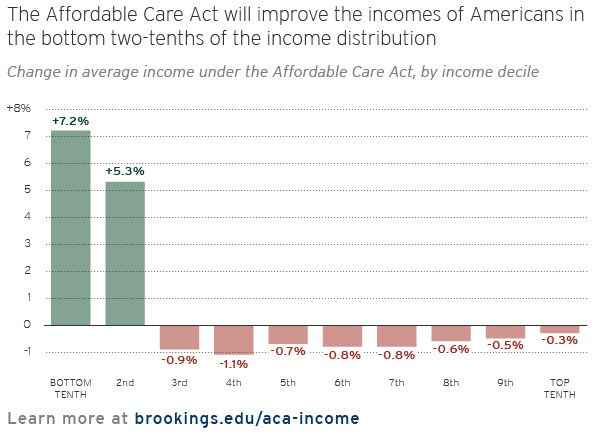
The Incidental Economist helpfully summarizes what I think is at the root of the AHCA--tax cuts for those with higher incomes.  They summarize a report from the Brookings Institution and the Urban Institute, which is summarized nicely in these two charts:

https://www.brookings.edu/wp-content/uploads/2016/07/acachart.jpg?w=599&crop=0%2C0px%2C100%2C434px


Notice anything?  Essentially, under the AHCA, those in the lower income brackets will see their incomes DECREASE, compared to a net INCREASE under the ACA.

Why this difference?  What is the driving philosophy behind reducing incomes of already low-income Americans in favor of increase incomes of the already well to do?

Rep. Mo Brooks from Alabama may have inadvertently told us why--folks who are sicker are so because of poor lifestyles, choices, or behaviors, and should pay more than healthy folks. Here is the money quote:

"And right now, those are the people who have done things the right way that are seeing their costs skyrocketing"

Others have chimed in with similar sentiments:
"That doesn't mean we should take care of the person who sits at home, eats poorly and gets diabetes." --Mick Mulvaney, WH Budget Chief

"Best to mandate nothing. Let the customer decide. A 60-year-old couple doesn’t need maternity coverage. Why should they be forced to pay for it? And I don’t know about you, but I don’t need lactation services."--Charles Krauthammer, Washington Post Columnist

While these are politically minded statements, it is not uncommon to hear similar sentiments in Chrisitan circles as well.  How many have expressed feelings of anxiety or depression to their Christian friends, only to be met with the verse from Philippians ("Don't  be anxious about anything...through prayer and petition...") or Psalms ("The righteous cry out, and the Lord hears them; he delivers them from all their troubles."

Articles like this from Charisma Magazine certainly do not help, clearly indicating that illness is due to a lack of faith and obedience.  It also takes little time to do a search for stories of people with chronic illnesses being chastised by their fellow believers for their 'lack of faith' (see here, for example).

The clear implication, from both camps, is that if you are poor, sick, or otherwise in a bad way, it is not only your fault, but your lack of effort (either through work or faith) are preventing you from pulling yourself out of it.  Never mind any structural issues that may be preventing you from doing so (i.e. lack of job opportunities, medical debt, barriers due to the conditions, etc. - another discussion for another day).

I think once you understand this underlying philosophy, that is both in conservative and Christian minds, you can better understand how certain policies are created and advocated for by these folks, despite their apparent harm.


Monday, April 24, 2017

Maternity care being left behind--where are the pro-life activists now?

Those who live, work, or know about rural areas understand the disadvantages in these communities.  One of the most significant is in the health care access, where there is often a lack of providers, hospitals, or key services within their county.
Some key highlights of rural counties in the US in 2010:
  • 12.5% without a primary care provider
  • 58.8% without an OB/GYN
  • 56.1% without a pediatrician
  • 20.5% without a hospital
  • 56.1% without a hospital that offered obstetric services
  • 94.4% without a community mental health facility 
Recent work by the University of Minnesota further examined the availability of obstetric service in rural areas, showing similar results.  This work further examined the availability by state, demonstrating great variability; specifically, 25 states had half or more of their counties with a unit. Those with the largest proportion of countries without services included North Dakota, Florida, Virginia, Arkansas, Nevada, and South Dakota.

These closures affect, not surprisingly, the smaller counties across the US.

Why are these units closing?  In short, due to money. Rural hospitals are, by default, low volume facilities.  Many rural OB usnits see few patients (relatively speaking) per year, many with less than 100 births per year.  This is due in part to the small local population, as well as patients skipping their local hospital to one further away.  

The reasons for closure are fairly straightforward: low volumes means the facility loses money on each birth due to the high fixed costs of delivery care (e.g. malpractice, training, equipment, and the like).  OB units that do close are smaller, privately owned, and in areas with lower socioeconomic status as well.  It is difficult to blame these hospitals for their closures; their overall margins are so low (and often negative) that losses in one unit are very difficult to subsidize with other services.  


These women are now forced to travel further away for care, on average 29 additional miles.  The further these women need to travel to seek care, the higher the mortality and NICU rates are--clearly indicating a relationship between the two.

Why is there not more alarm for this?  Where are the pro-life groups rallying to support these women and rural facilities, so they can care for these pregnant women and children?  Searching some of the major pro-life groups yields nothing on this topic--why is that?  Why is there so much concern about contraception, abortion, and planned parenthood, and so little on caring for those vulnerabel in our community?


Thursday, March 16, 2017

Pious Paul of Ryan


If you have not yet read this article, go do it now:

And Jesus said unto Paul of Ryan

This in so many ways highlights the conflict between conservative beliefs about poverty and health care and the teachings of t Jesus of Nazareth guy:


The highlights:

  • "When you cure her, she learns dependency. Then the poor won’t take care of themselves..." 
  • "And don’t worry about them — they’ve already got health care access."
  • "Why, they can pray for a cure,” Pious Paul explained. “I call that universal health care access."
  • "For the Samaritan’s work is unsustainable and sends the wrong message."
  • "And you need to give people freedom, Jesus, the freedom to suffer misery and poverty"
  • "That then inspires the poor to work harder, galvanizes the sick to become healthy, forces the lepers to solve their own problems rather than kick back and depend on others."
  • "But, Lord,” protested Pious Paul of Ryan, “when did I see you hungry or thirsty or sick and refuse to help you? I drop your name everywhere. And I’m pro-life!
The author sums it up nicely, paraphrasing Jesus' own words here:

Truly, I say to you,” Jesus responded, “as you did not help the homeless, the sick — as you did not help the least of these, you did not help me.”

Sunday, March 12, 2017

"The poor will always be with us"


Representative Roger Marshall (R, Kansas) created some controversy when discussing Medicaid expansion and coverage cutbacks in the proposed AHCA legislation.  His full quote:
Just like Jesus said, ‘The poor will always be with us. There is a group of people that just don’t want health care and aren’t going to take care of themselves....Just, like, homeless people. … I think just morally, spiritually, socially,  just don’t want health care. The Medicaid population, which is a free credit card, as a group, do probably the least preventive medicine and taking care of themselves and eating healthy and exercising. And I’m not judging, I’m just saying socially that’s where they are. So there’s a group of people that even with unlimited access to health care are only going to use the emergency room when their arm is chopped off or when their pneumonia is so bad they get brought the ER.

The idea that those who live in poverty are so either due to poor choices, objectionable lifestyles, or some other personal flaw is not uncommon:
  • Trump's comments about a lack of incentives for the poor to work
  • Rick Perry implication that income inequality is not an issue
  • Hillary Clinton suggesting those on welfare were undignified and dependent
Stephen Pimpare summarizes the many reasons why this is not the case here, including:
  • Poor employment opportunities (low wages or none at all)
  • Poor educational opportunities
  • Higher crime and  incarceration rates (more single parent homes)
  • High day care costs
  • Lack of upward mobility

Despite these differences (and reams of strong research to support it), the supposition that poverty is more of a choice than a circumstance perseveres.  This myth often leads those who hold this belief to the conclusion that in order to best help those in poverty, the government must withhold government assistance, not provide it.  This will, in theory, spur on those in poverty to work harder and pull themselves out of the situation.

This theory does not, however, align with the very passage that Rep. Marshall quotes.  When Jesus said "The poor will always be with you" he was referring to a well-known and well understood verse in Deuteronomy:
If among you, one of your brothers should become poor, in any of your towns within your land that the Lord your God is giving you, you shall not harden your heart or shut your hand against your poor brother, but you shall open your hand to him and lend him sufficient for his need, whatever it may be ... For the poor you will always have with you in the land. Therefore I command you, ‘You shall open wide your hand to your brother, to the needy and to the poor, in your land.’ (Deuteronomy 15:7-11)
See the difference?   God is telling his people:
Therefore I command you, ‘You shall open wide your hand to your brother, to the needy and to the poor, in your land.’ 
While a case may be made for responsible government spending on social programs, the case for those who claim to follow God seems clear--to open your hand, and not to close it.


Thursday, March 9, 2017

Faith in Health Reform

Health care reform is a major topic in the news, with the election of Donald Trump and the Republican promise to ‘repeal and replace’ the Affordable Care Act (ACA, aka. Obamacare).  With the recent release of the American Health Care Act (AHCA), the debate has intensified, as those on both sides of the debate now have a tangible framework to discuss.

The AHCA and the rhetoric around the ACA and health care, in general, is fascinating from a health policy perspective.  It is, however, rather disheartening to see the reaction from people of faith to these programs and proposals. Faith-based arguments against the ACA and expansion of health care have included:


  • Elected officials using Jesus’s words to justify the denial of coverage to poor citizens ()
  • The Christian Coalition's agenda includes repeal of the ACA, with assertions about federal funding of abortions 
  • Concerns about religious freedom and provision of contraceptives 
  • Physicians recently won the right to refuse to treat transgender patients or women who have had an abortion 
  • Other concerns about federal power and tax policy being intrusive upon general personal freedoms 

Of course, there are examples of those standing up for the morality of health care:
  • Ohio Gov. Kasich defends expansion of Medicaid by referring to the bible 
  • Sitting congressman cites scriptures to question the AHCA proposal 

So, what is a person of faith to do in regards to health care and reform? That is what we hope to explore here on this blog.  We will be posting reactions to news of the day (e.g. controversial statements, movements in legislation or policy, etc.), as well as explore some bigger topics in depth (e.g. abortion, contraception, Medicaid, etc). 

Overall, we seek to aid in thinking through these issues, based on objective data (where possible), with the goal towards more unity among people of faith.  We will have guest bloggers from health policy, medicine, community development, and different faith and faith-based organizations to help us see these debates in a well-rounded and comprehensive way.  We will purposefully seek to make this a non-partisan discussion by including voices from a variety of backgrounds and positions.  Your feedback will help us to do just that.